You want to run Claude locally — fast responses, your data staying on your desk, no quota anxiety. Here's the honest version up front: you can't run Claude's actual weights offline. Claude is a closed cloud model, and Anthropic does not release its parameters for local download. But that doesn't mean you're stuck choosing between "everything in the cloud" or "nothing at all." With a local-first setup, you run capable open-weight models on your own hardware for most work, and call Claude as an optional cloud provider only when you want its specific strengths. This guide explains what "run Claude locally" realistically means, how the architecture works, and what hardware makes it practical.
What "Run Claude Locally" Actually Means
When people search for how to run Claude locally, they usually want one of three things: privacy, speed, or independence from a subscription meter. The good news is you can get most of that without Claude's weights ever leaving Anthropic's servers.
The realistic model is local-first with optional cloud. A local-first agent runs open-weight models — like Llama, Qwen, or Mistral variants — directly on hardware you own. Those models handle the bulk of everyday tasks: summarizing, drafting, classifying, answering questions about your files. When a task genuinely benefits from a frontier cloud model, the agent routes that single request to Claude's API and brings the answer back. You stay in control of what goes out and what stays home.
So "running Claude locally" is shorthand for "running a local-first AI stack on your hardware that can also reach Claude when you choose to." That's a far more useful and honest framing than pretending you can extract a cloud model onto a box under your desk.
Why Open-Weight Models Cover Most of the Work
Modern open-weight models in the 7B–14B range are dramatically more capable than the models of even a year ago. For a large share of real tasks — note-taking, code completion, document Q&A, classification, routine automation — a well-chosen open model running locally is fast, private, and entirely yours. No request leaves your network.
Running these models locally gives you three concrete wins:
- Privacy by default. Prompts and documents are processed on-device. Nothing is logged on a third-party server unless you deliberately send it there.
- Predictable cost. Local inference draws electricity, not API credits. You scale usage without watching a meter.
- Low latency. No round-trip to a data center for the common case.
You can learn more about how on-device inference works in practice on the private AI overview. The point isn't that open models replace Claude — it's that they handle enough of the workload that Claude becomes a precision tool you reach for deliberately, not a dependency you pay for on every keystroke.
Calling Claude as an Optional Cloud Provider
For tasks where a frontier model earns its keep — complex reasoning, long-context analysis, nuanced writing — you'll still want Claude. A local-first agent makes this a configuration choice, not an architecture rewrite.
Here's how the routing works in a sensible setup:
- A request comes in to your local agent.
- The agent decides — by rule, by task type, or by your explicit instruction — whether to answer locally or escalate.
- If it escalates, it sends only that request to Claude's API over an encrypted connection and returns the response.
You supply your own Anthropic API key, so the cloud relationship is direct and transparent: you see exactly what's billed and exactly what was sent. Everything else stays local. This is what local-first with optional cloud means in practice — the default is your hardware, and Claude is opt-in per task.
If you're choosing between providers, the model-selection logic lives in the agent layer, so you can swap Claude for another cloud model — or turn cloud off entirely — without rebuilding anything.
The Hardware That Makes Local-First Practical
A local-first stack needs hardware that can run open-weight models at usable speed without turning into a space heater or a server-room project. This is where most DIY attempts stall: a gaming GPU is loud and power-hungry, a cheap mini-PC is too slow, and a cloud VM defeats the entire purpose.
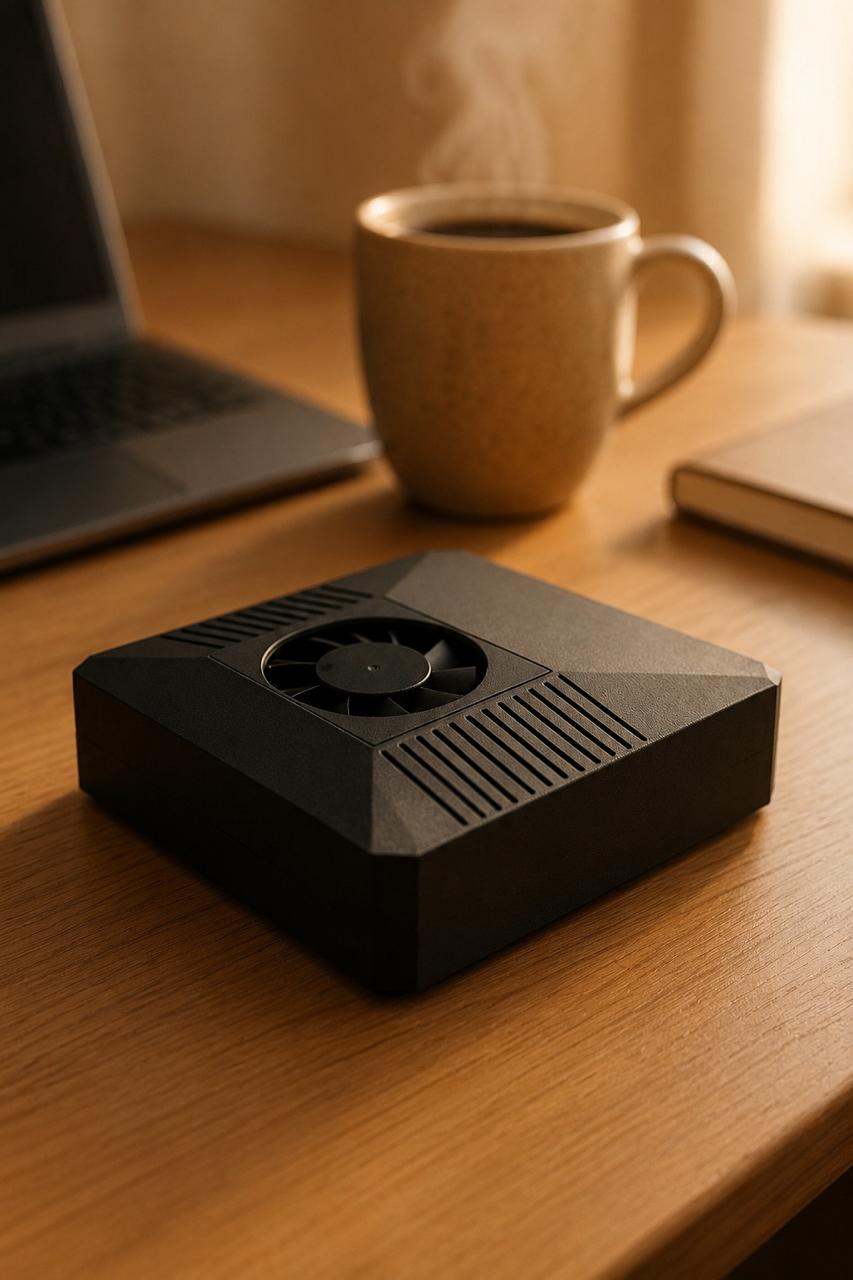
ClawBox is built for exactly this gap. It's a compact edge device with:
- NVIDIA Jetson Orin Nano Super (8GB) — purpose-built for on-device AI inference
- 67 TOPS of compute for running open-weight models locally
- 512GB NVMe storage for models, context, and your data
- ~20W typical draw — quiet, cool, always-on friendly
- OpenClaw pre-installed — the local-first agent that handles routing between local models and optional cloud providers like Claude
- €549 one-time for the hardware
OpenClaw is the piece that ties it together: it runs your local models, manages context, and lets you wire in Claude as an optional provider when you want it. The Jetson platform is what makes running real models on ~20 watts feasible — you can read more about that pairing on the OpenClaw on Jetson page, or compare options on the best hardware for local AI guide.
Setting It Up Without the Headaches
The reason people give up on local AI isn't the idea — it's the assembly. Drivers, CUDA versions, model quantization, agent frameworks, and API plumbing add up to a weekend you didn't budget. A pre-configured device removes that friction: OpenClaw and its dependencies are already installed and tuned for the Jetson, so you go from unboxing to running local models in minutes, then add your Claude API key whenever you want cloud escalation.
For configuration specifics — adding providers, choosing local models, setting routing rules — the documentation walks through each step. You stay the decision-maker; the box just removes the yak-shaving.
FAQ
Can I run Claude's actual model offline on ClawBox? No. Claude is a closed cloud model and Anthropic does not release its weights. ClawBox runs open-weight models locally and lets you call Claude's API as an optional cloud provider when you choose to.
Do I need a Claude subscription to use ClawBox? No. ClawBox is local-first — open-weight models run on the device with no cloud account required. Claude is optional: if you want it, you connect your own Anthropic API key. The €549 hardware purchase is one-time.
Is my data sent to the cloud? Only when you explicitly route a request to a cloud provider. By default, everything runs on-device, so prompts and documents stay on your hardware.
Ready to Go Local-First?
You don't have to choose between privacy and capability. Run open-weight models on your own hardware for the everyday work, and keep Claude one configuration away for when you need it — all on a quiet, ~20W box that's yours outright.
See the full specs and start your local-first setup at clawbox.tech.